InvoicesCrafts
What is an invoice line item?
A line item is one entry in the invoice's list of charges. It usually combines a description, quantity, unit price or rate, and line amount. Separate entries help the customer see which goods or services make up the total rather than receiving a single unexplained figure.
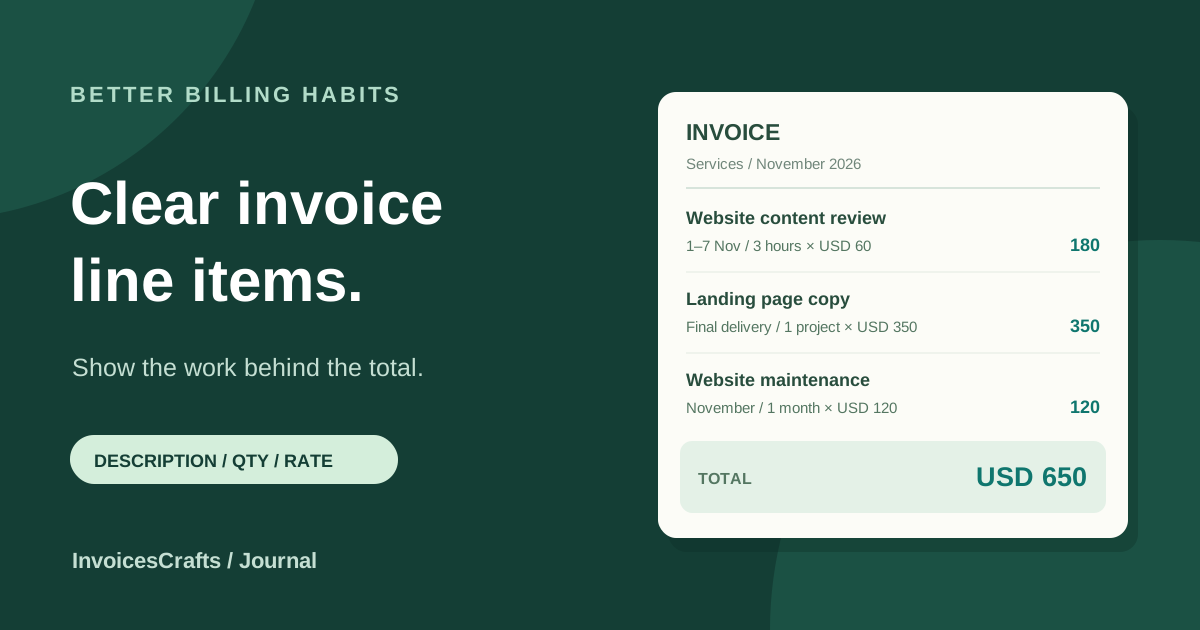
For example, Website content review, 1–7 November 2026, with a quantity of 3 hours and a rate of USD 60 per hour, explains a USD 180 charge. The description identifies the work, while the quantity and rate explain the calculation. Make the unit clear so a quantity of 3 cannot be mistaken for three pages or three projects.
Use a simple formula for the description
Start with the service or product name, add the deliverable or scope, and finish with a period or milestone when it helps identify the work. You do not need all three parts on every line. Include the details that distinguish this charge from another one for the same customer.
Instead of Design work, write Homepage layout design, milestone 2. Instead of Maintenance, write Website maintenance, November 2026. For goods, identify the product and a useful specification, such as A5 notebooks, blue cover, rather than using an internal stock code alone.
Use terms the customer already knows from the quote, purchase order or project agreement. If the buyer calls the deliverable a homepage layout, changing it to digital creative services makes the invoice harder to match. Keep internal task codes as additional references when they are needed.
Match the quantity and rate to the way you priced the work
For hourly work, show the hours and the agreed hourly rate. Website content review, 3 hours at USD 60 per hour, produces a USD 180 line amount. Use a consistent time format: 1 hour 30 minutes is 1.5 hours when you calculate with decimal hours, not 1.30 hours.
For a fixed project fee, a quantity of 1 can represent the named deliverable or milestone. Landing page copy, final delivery, 1 project at USD 350, is clearer than inventing hours for a project that was agreed at a fixed price. For a monthly service, name the billing month and make clear whether the charge covers one month or another agreed period.
Use separate lines when the rates, deliverables or billing periods differ. If you combine several units on one line, confirm that the description applies to every unit and that the customer can follow the calculation.
Check the description against the agreed scope
Compare each entry with the accepted quote, order or written agreement before sending. Check the deliverable name, quantity, rate and stage of work. If the invoice covers only one milestone, name that milestone so the customer does not read it as a charge for the entire project.
Describe separately approved extra work on its own line, using the wording and reference from the approval where helpful. A clearer description cannot resolve a disagreement about the scope or price. Resolve that difference with the customer before treating the charge as agreed.
Keep supporting detail readable
Aim for a description that makes sense without opening another file. A timesheet or delivery record can support the line, but a label such as See attachment gives the customer no immediate explanation of the charge. Use the invoice for the recognizable summary and provide the detailed record through the customer's preferred submission method.
For example, Website content review, 1–7 November 2026; timesheet TS-018, identifies the work and points to the record. Avoid copying every internal comment or a long project history into the line item. Open the exported PDF and check that the description wraps cleanly and that the quantity, rate and amount are easy to read.
A checklist for clearer invoice line items
Read each entry as if you were the person approving the invoice. The customer should be able to recognize the work and understand the charge from the information you provide.
- Name the actual service, deliverable or product instead of using Services or Miscellaneous.
- Add the work period, billing month or milestone when it distinguishes the charge.
- Use wording the customer recognizes from the agreement or purchase order.
- Make the quantity's unit clear and check it against the agreed rate.
- Separate charges with different rates, deliverables or billing periods.
- Reference supporting records where needed, then review every line in the saved PDF.
Worked example: three descriptions the customer can check
A fictional USD invoice combines hourly work, a fixed deliverable and a monthly service. No tax, discount or previous payment is included in this example.
- Website content review, 1–7 November 2026
- 3 hours × USD 60 = USD 180
- Landing page copy, final delivery
- 1 project × USD 350 = USD 350
- Website maintenance, November 2026
- 1 month × USD 120 = USD 120
- Invoice total
- USD 180 + USD 350 + USD 120 = USD 650
Common questions
What should I write in an invoice description?
Name the goods or services supplied in wording the customer recognizes. Add the relevant deliverable, period or milestone, and pair the description with a clear quantity and agreed rate.
How detailed should an invoice line item be?
Include enough detail to identify the charge and match it to the agreement. Keep longer timesheets or delivery records as supporting documents, and use a short reference to connect them to the invoice.
Can I use a quantity of one for a fixed project fee?
Yes. Identify the project deliverable or milestone and use the agreed fee as the rate for that one item. Do not present it as hourly work if the price was agreed as a fixed amount.
Should monthly services include a date range?
Include the billing month or service period so the customer can distinguish one recurring charge from the next. Use the period agreed with the customer and check that it matches the work being billed.