InvoicesCrafts
Invoice vs receipt: what is the main difference?
The practical difference is the question each document answers. An invoice explains what the customer is being charged and what they need to pay. A receipt explains which payment you have received. Both can name the same customer and work, but the amount billed and the amount received may be different.
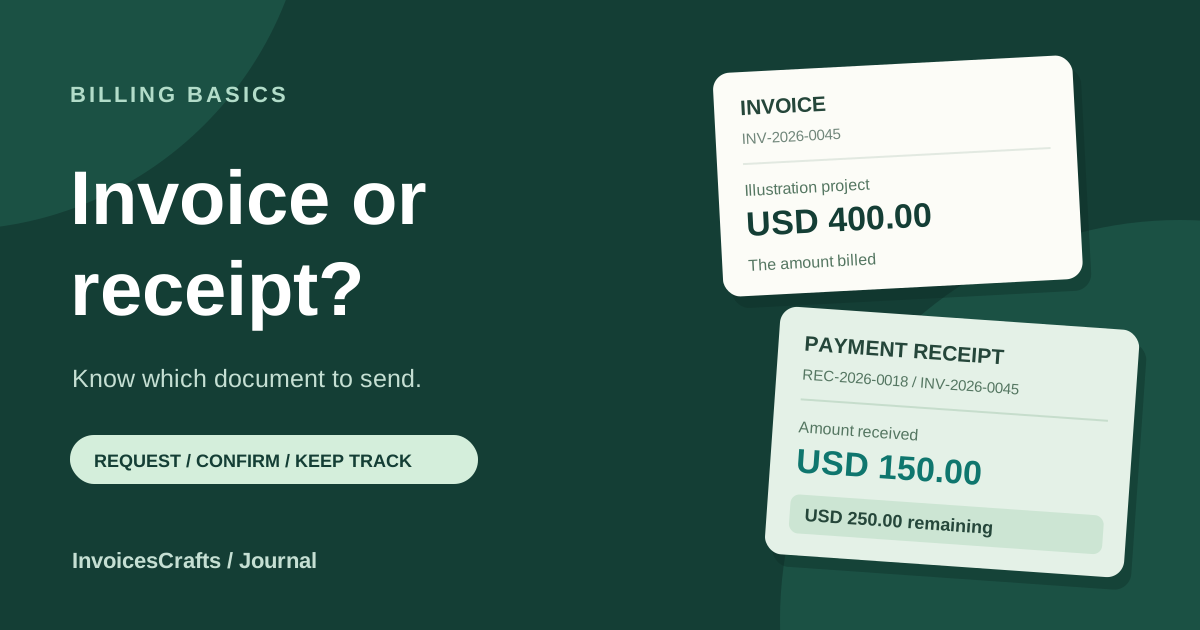
For example, an invoice for USD 400 of design work requests payment for that work. If the client pays USD 150, a receipt can acknowledge that payment while the invoice still has USD 250 outstanding. Keep the two amounts clearly labeled so the client can see both the original charge and the payment already recorded.
When should you send an invoice?
Send an invoice at the billing stage agreed with your customer. That might be a project milestone, delivery of the work or the end of a service period. Include recognizable descriptions and the agreed prices so the customer can compare the bill with the order or proposal.
A useful invoice identifies the seller and customer, has its own invoice number and issue date, and shows the line items, currency, total and balance due. Include the agreed due date, payment instructions and any customer reference needed for approval. Sending the invoice does not establish that the client has paid it.
When should you send a payment receipt?
Prepare the receipt after checking the payment in your own records. Record who paid, the amount and currency received, the payment date, the method and a transaction reference when available. Refer to the invoice or order the payment belongs to so both parties can find the related document.
Give the receipt its own reference, such as REC-2026-0018, and record the related invoice separately as INV-2026-0045. Distinct references help you identify which document a customer is discussing. A payment screenshot from the customer is useful context, but compare it with your own payment records before confirming the amount received.
How do invoices and receipts work with partial payments?
Suppose North Studio issues INV-2026-0045 for a completed illustration project totaling USD 400. The client makes a USD 150 payment against that invoice. North Studio checks the transfer and prepares a receipt identifying the USD 150 received and the invoice it relates to. With no other payments or adjustments, the remaining balance is USD 250.
The receipt acknowledges the payment already made; a follow-up message about the same invoice should ask only for the amount still outstanding. Keep the invoice's existing reference in that message. If another payment arrives later, record it before calculating the next balance rather than continuing to use the figure from the first receipt.
Check whether a payment figure represents one transaction or the total received to date. For example, two transfers of USD 150 and USD 100 total USD 250, leaving USD 150 against a USD 400 invoice. Label individual payments and cumulative amounts clearly in your records so you do not subtract the same payment twice.
Create an invoice or receipt in InvoicesCrafts
Start with the standard invoice generator when you need to prepare a bill. Enter the customer, work, currency, dates and agreed charges, then review the totals and payment instructions. Use the receipt generator when you want to prepare a document acknowledging a payment.
The receipt template includes a payment date, payment method, received amount and transaction reference. Its preview shows the document total, amount received and remaining balance. For the single-payment example above, a document total of USD 400 and a received amount of USD 150 show USD 250 remaining. Enter and review the figures yourself against your payment records.
For either document, use the template's print or PDF action to save a copy, then open it and check every page before sharing through your normal email or delivery method. Creating a receipt PDF records the information you enter; it does not collect a payment or verify a bank transfer.
Keep the invoice, receipt and payment record together
Store the issued invoice, payment receipt and relevant transaction record with the same customer or project. A simple register can track the invoice reference, total, payments received and current outstanding balance. Use the currency code alongside every amount, especially if the customer has invoices in more than one currency.
When the customer asks for an invoice after you have already sent a receipt, clarify which document their billing team needs. The receipt describes the payment; the invoice explains the underlying charges. Providing the related document with a short explanation helps them match the records without treating it as another request to pay the full amount.
A checklist before sharing either document
Read the finished PDF from the customer's point of view. They should be able to identify the work, the payment being discussed and any balance still due without comparing unexplained totals.
- Choose the document that matches your purpose: request payment or acknowledge a payment received.
- Check the customer name, document number and date.
- Keep invoice and receipt references distinct and record their relationship.
- Distinguish the original charge, payment received and remaining balance.
- Match the currency and payment details to your records.
- Review the final PDF and keep a matching copy with the transaction.
Worked example: one invoice and a partial-payment receipt
A fictional illustration project with an agreed final invoice total of USD 400. No other payments, credits or adjustments apply to this example.
- Invoice reference
- INV-2026-0045
- Work billed
- Illustration project, approved final artwork
- Invoice total
- USD 400.00
- Payment received
- USD 150.00 by bank transfer on 30 October 2026
- Receipt reference
- REC-2026-0018, related to INV-2026-0045
- Payment reference
- BANK-3010-18, recorded with the receipt
- Remaining balance
- USD 400.00 − USD 150.00 = USD 250.00
- Next follow-up
- Refer to INV-2026-0045 and check the current balance before requesting payment
Common questions
Is an invoice the same as a receipt?
No. An invoice requests payment and describes the charges. A receipt acknowledges a payment received. Link the two in your records when the receipt relates to an invoice.
Does sending an invoice mean the customer has paid?
No. Check your payment records before treating an invoice as paid. The invoice total describes the charges, while the outstanding balance depends on the payments and adjustments recorded against it.
Can I give a receipt for a partial payment?
Yes. State the amount received, identify the related invoice and make the remaining balance clear. For a USD 400 invoice with a single USD 150 payment and no other adjustments, USD 250 remains outstanding.
Should the invoice number and receipt number be the same?
Use distinct references to identify the two documents, and record the related invoice reference on the receipt. For example, receipt REC-2026-0018 can acknowledge a payment against invoice INV-2026-0045.
Can I create both documents in InvoicesCrafts?
Yes. Use the standard invoice generator to prepare a bill and the receipt generator to record a payment received. Review the entered details and save each finished document as a PDF before sharing it.